Laser hair reduction is one of the treatments we're asked about most at Zazura, our skin and laser clinic in Gilesgate, Durham. We take a consultation-led approach: before any treatment is booked, we assess your skin and hair, talk through what you're hoping to achieve, and make sure laser is genuinely the right option for you.
We'll also be straightforward with you when it isn't.
Every laser appointment at Zazura begins with a consultation and, where required, a patch test — not because we want to add steps, but because that's the responsible way to deliver laser safely and to set realistic expectations from the start.
How Laser Hair Reduction Works
Laser hair reduction works by delivering controlled light energy into the hair follicle. The pigment (melanin) within the hair absorbs this energy and converts it into heat, helping to disrupt the follicle's ability to produce hair.
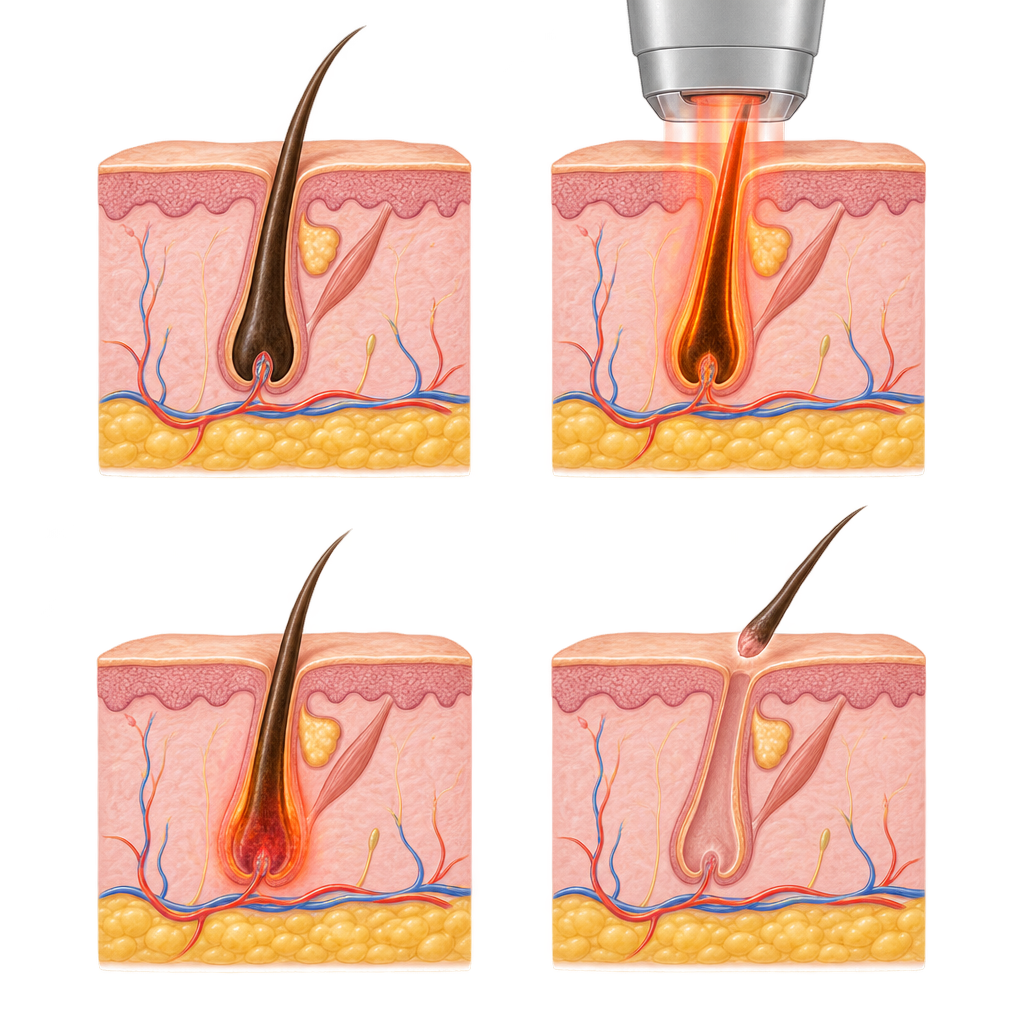
- 01
Target
The laser is directed towards the treatment area, where pigment within the hair absorbs the light energy.
- 02
Heat
The absorbed energy is converted into controlled heat within the hair and follicle.
- 03
Follicle
This thermal effect targets the follicle while minimising damage to the surrounding skin.
- 04
Shed
Following treatment, successfully treated hairs gradually shed. Because individual hairs are at different stages of the growth cycle, multiple sessions are required for progressive, long-term hair reduction.
Laser is most effective on hairs in the active (anagen) growth phase, which is why treatments are spaced apart and completed as a course.
Ready to start your laser journey?
Book Consultation & Patch TestLaser hair reduction at Zazura
You'll notice we use the phrase laser hair reduction rather than “permanent hair removal”. That's a deliberate choice.
Laser works by targeting the pigment in the hair and reducing hair growth in the treated area over a course of sessions. For many people the result is a long-lasting, significant reduction in hair growth, and the hair that does return is often finer and lighter. What laser can't honestly promise is that every single hair will be permanently gone forever — hair growth is influenced by factors like hormones, genetics and the hair's natural growth cycle, so “reduction” is the more accurate word.
We'd rather describe it honestly than overstate what's achievable.
Is laser hair reduction right for me?
Laser hair reduction works well for a lot of people, but not for everyone, and not for every hair and skin type. Suitability depends on factors including:
- your hair colour and hair characteristics
- your skin type
- the area you'd like treated
- your medical history and any current medications
- recent or planned sun exposure and tanning (including fake tan)
- hormonal factors and certain underlying conditions
Why pigment matters
Laser relies on pigment in the hair. Hair with little or no pigment — light blonde, grey, white and some red hair — often doesn't respond well to laser, because there isn't enough pigment for the laser to target. We'll be honest with you about this at consultation rather than taking a booking we don't think will work.
Some skin types need a more careful approach, and some situations mean laser isn't advisable at all. Rather than list every possibility here, we assess it properly in person — that's the point of the consultation.
The laser technology we use
Zazura uses a quad-wavelength diode laser platform. In plain terms, the device delivers laser energy through four wavelengths in one handpiece.
Diode laser is one of the established approaches used for laser hair reduction. The four wavelengths are designed so the energy can be absorbed by pigment in the hair across different hair and skin characteristics.
What we won't do is tell you that this device makes us suitable for everyone. It doesn't. Whether laser is appropriate for you — and how well it's likely to work — depends on your individual hair colour, skin type, medical history and several other factors we assess at consultation. The technology is a tool; the judgement about whether and how to use it on you is what the consultation is for.
- 755 nm
- 808 nm
- 940 nm
- 1064 nm
Your consultation and patch test
We don’t start laser treatment on the same day as your first visit. Your first appointment is a consultation, and it’s where we do the work that makes treatment safer and more effective. At your consultation we assess your skin and hair, talk through the area you’d like treated and what you’re hoping to achieve, assess your suitability including relevant medical history and medications, explain what a realistic course would look like for you, go through transparent pricing, carry out a patch test where one is required, and answer any questions — with no pressure to commit on the day.
A patch test is a small test exposure of the laser, carried out before a full treatment, so we can check how your skin responds. It’s a standard part of safe laser practice, not an extra hurdle.
- Consultation
- Assessment
- Patch test
- Treatment plan
What areas can we treat?
Common areas we treat with laser hair reduction include:
- Face
- Upper lip
- Chin
- Neck
- Underarms
- Arms
- Bikini
- Brazilian
- Chest
- Abdomen
- Back
- Legs
If the area you’re thinking about isn’t listed, ask us at consultation and we’ll let you know whether it’s something we treat.
Facial hair on the chin, upper lip, jawline or neck linked to PCOS or hormones? Read our PCOS & hormonal hair growth page
How many sessions will I need?
Laser hair reduction is normally delivered as a course of sessions rather than a one-off treatment. At any given time, the hairs in an area are at different stages of the growth cycle, and laser is most effective on hairs in the active growth stage. A course of sessions, spaced out over time, is what allows us to treat each hair at the right point in its cycle.
The number of sessions someone needs varies — it depends on the area, your hair and skin, and how your hair responds. You'll get a realistic indication at consultation, based on your assessment.
What does treatment feel like?
Most people describe laser hair reduction as uncomfortable rather than painful. The sensation is often compared to a quick, hot snap or a rubber-band flick against the skin, and the device we use includes cooling to help make treatment more comfortable.
We won't promise “pain-free” treatment, because that's not an honest description for everyone. How it feels varies from person to person and from area to area. At consultation we can talk through what to expect for the area you're considering.
What happens after laser treatment?
After a session it's common for the skin in the treated area to be a little red or warm for a short time. Some people notice the treated hairs appear to “grow” and then shed over the following couple of weeks — this is the treated hairs pushing out, not regrowth.
We'll give you specific aftercare guidance based on your treatment and skin, talked through at your appointment.
What laser hair reduction cannot promise
We think it’s important to be clear about what laser can’t do, so you can make a properly informed decision.
Results vary between people
Two people with similar-looking hair and skin can have somewhat different outcomes.
Complete, permanent removal can't be guaranteed
Most people see a significant, long-lasting reduction; “every hair gone forever” isn't an honest promise.
Maintenance may sometimes be needed
Some people benefit from occasional top-up sessions after a course.
Hormonal factors can influence results
Conditions such as PCOS, and hormonal changes generally, can affect hair growth and how well laser holds.
Some hair colours may not respond effectively
Light blonde, grey, white and some red hair often don't have enough pigment for laser to work well.
None of this is meant to put you off — it’s meant to make sure you’re deciding based on how laser genuinely behaves. If you’d like to understand how these factors apply to you, that’s exactly what the consultation is for.
Laser hair reduction prices
Zazura has transparent, published treatment prices. You don't need to attend a consultation simply to find out what laser costs — you can see our pricing before you book.
- Sideburns£20
- Ears£20
- Neck£30
- Upper lip£25
- Chin£25
- Beard shaping£40
- Upper lip & chin£35
- Full face£60
- Nipple area£25
- Bikini line£45
- Underarms£45
- Shoulders£50
- Half arms£55
- Chest£50
- Half back£55
- Abdomen£55
- Half legs£65
- Brazilian£65
- Full back£70
- Hollywood£85
- Full arms£80
- Chest & abdomen£90
- Full legs£105
- Consultation & patch test£20 consultation and patch test — deducted from your first treatment when proceeding.£20
The consultation is where we assess suitability, agree the right treatment plan for you and answer your questions — not where you find out the price for the first time. See the full price list.
Why choose Zazura for laser hair reduction?
- An independent, family-run clinic in Gilesgate, Durham — not a chain or a franchise.
- A consultation-led approach. We assess you first and recommend what's appropriate, rather than selling from a fixed menu.
- Patch testing and individual assessment before treatment, as standard.
- Quad-wavelength diode laser technology, used with judgement about whether it's right for you.
- Transparent pricing you can see before you book.
- Realistic expectations. We'll tell you what laser can and can't do for your situation.
- A trained practitioner. Samira holds the VTCT Level 4 Certificate in Laser and Light Treatments.
- No pressure to proceed. You're not required to buy a course on the day of your consultation.
Frequently asked questions
Does laser hair reduction hurt?
Most people find it uncomfortable rather than painful — often described as a quick hot snap against the skin. The device includes cooling to help. Sensation varies by person and by area.
How many sessions will I need?
Laser is normally delivered as a course because hairs move through different growth cycles. The number varies by area, hair and skin, and how your hair responds. We'll give you a realistic indication at consultation.
Does laser work on blonde hair?
Often not well. Laser relies on pigment in the hair, and light blonde hair may not have enough pigment to respond effectively. We'll be honest at consultation about whether laser is likely to work for you.
Can laser work on grey or red hair?
Grey and white hair typically don't respond well to laser for the same reason — limited pigment. Some red hair may respond, but results are less predictable. We assess this in person.
Can I have laser treatment if I have PCOS?
Laser hair reduction can be an option for people with PCOS-related hair growth, though hormonal factors can influence results and maintenance may be needed. We'll discuss your individual situation at consultation.
Why do I need a patch test?
A patch test is a small test exposure of the laser so we can check how your skin responds before a full treatment. It's a standard part of safe laser practice.
Will the hair grow back?
Laser aims to reduce hair growth long-term, but complete permanent removal can't be guaranteed. Some people may need occasional maintenance sessions, and hormonal factors can influence regrowth.
Can darker skin be treated?
Darker skin can often be treated, but it requires a careful, individual approach and proper assessment. Suitability depends on your skin type and several other factors we assess at consultation.
Can I have laser treatment if I have a tan?
Active tanning — natural or fake — can affect suitability and safety. We'll advise you based on your current skin and sun exposure at consultation.
Does laser hair reduction work on all skin tones and hair types?
Our multi-wavelength diode laser lets us adapt treatment to a wide range of skin tones, but it isn't right for everyone. Laser works best on hair with pigment, so very light blonde, grey, white and some red hair may not respond well. We'll be honest with you at your consultation about whether laser is likely to work for you.
How much does laser hair reduction cost in Durham?
Our prices start from £20 per session for small areas such as sideburns or ears, up to £105 for full legs. Six-session courses are also available. Every price is published on our Treatments & Prices page. Your first visit is a £20 consultation and patch test, which is deducted from your first treatment when you go ahead.
What should I do before and after a session?
Before: shave the area within about 24 hours, and avoid waxing, plucking, threading or epilating, since laser needs the hair root in place. Avoid tanning and fake tan too. After: you may notice some redness for a short while. Keep the area protected from the sun and follow the aftercare we give you. We'll talk you through everything at your consultation.
Do I have to buy a course upfront?
No. You're not required to commit to a full course on the day of your consultation.
If you're considering laser hair reduction and you'd like an honest view of whether it's right for you, the first step is a consultation.
You're welcome to come with questions and leave without committing to anything. If laser isn't the right option for you, we'll tell you — and if it is, we'll explain what to realistically expect.